

3 Balance laws
In previous chapters we have studied forces acting on a continuum, the resulting deformation of the continuum, and the stresses that are caused by the deformation. The relation between forces, deformation and stress is governed by two types of equations. The first type, the balance laws, are mathematical formulations of universal physical principles: balance of mass, momentum, and moment of momentum. These laws will be discussed in this chapter.
3.1Balance of mass
3.1.1Lagrangian approach
We consider a body with a volume , a surface area and a density in the reference state . In the deformed state the body occupies a volume while having a surface area and a density .
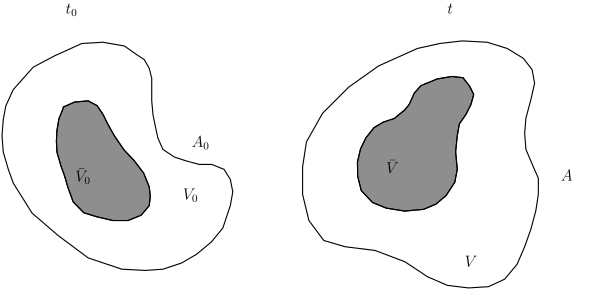
Figure 3.1:A body in the initial state and the deformed state , with arbitrary subregion .
To derive the law of balance of mass[1], we concentrate on an arbitrary, fixed amount of material points in a subregion , i.e. we use a Langrangian approach. In the initial state these material points occupied a volume while having a surface area and a density . According to the law of balance of mass, the mass of these material points must have remained constant during the deformation:
This equation is called the global formulation of the law of balance of mass. From the theory of kinematics, we know that the volumes before and after deformation are related as , where represents the determinant of the deformation tensor. Thus we can transform the left-hand integral into an integral over the undeformed volume:
which can also be written as:
Since this integral must hold for any arbitrary volume , it follows that the integrand must be zero:
This equation is called the local formulation of the law of balance of mass.
3.1.2Eulerian approach
The law of balance of mass can also be derived using an Eulerian approach. Here, we concentrate on a fixed arbitrary volume in space, with surface area . This volume is occupied by matter with a density . The total mass of the matter in this volume equals:
The rate of change in time of the mass in the volume equals:
According to the law of balance of mass, the change of mass within the volume can only be caused by mass transport across the boundary of the volume:
Application of Gauss’s theorem to convert the surface integral into a volume integral yields:
Now again, because the volume may be chosen arbitrarily, the integrand must be zero:
or, in elaborated form:
This local formulation of the equation of balance of mass is also called the continuity equation[2]. If we use the material time derivative of :
we obtain the following, slightly different form of the continuity equation:
The latter form is often used in fluid dynamics. These equations can also be derived directly by taking the material time derivative of the relation ,
3.2Balance of momentum
3.2.1Lagrangian approach
Again we concentrate on a certain, fixed amount of matter having a volume , a surface and a density . The matter is acted upon by body forces and surface forces .
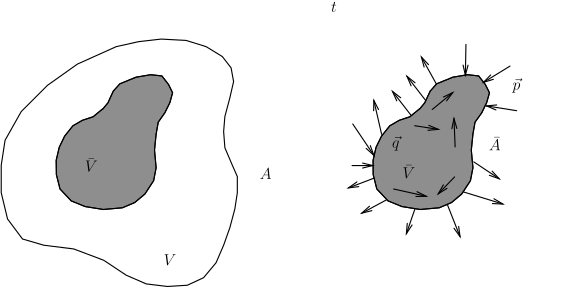
Figure 3.2:Forces and acting on a subvolume of a body.
The total momentum[3] of the matter equals:
The total resulting force , acting on the matter, is the sum of all body forces and surface forces:
where we have applied Gauss’s theorem[4] to convert the surface integral into a volume integral.
According to the law of balance of momentum[5], this resulting force is equal to the rate of change of the momentum of the matter in :
To elaborate the differentiation with respect to time, we convert the right-hand volume integral to the undeformed situation:
where we used the local form of the law of balance of mass (). The global formulation of the law of balance of momentum can thus be written as:
Now again, because the volume may be chosen arbitrarily, the integrand must be zero, yielding the local formulation of the law of balance of momentum:
These equations are also called Cauchy’s equations of motion[6]. In case of static equilibrium, the acceleration is zero, and the equations of motion are reduced to the equilibrium equations[7]:
3.2.2Eulerian approach
Again we concentrate on a fixed volume in space, with surface area . The rate of change of momentum of the matter in this volume equals:
The first term on the right-hand side represents the change of momentum of the matter remaining within the volume, while the second term represents the change of momentum due to transport of matter across the boundary. According to the law of balance of momentum the rate of change of momentum is equal to the resulting force on the matter:
where Gauss’s theorem was applied for conversion to volume integrals. Using the local formulation of the law of balance of mass, and considering arbitrary volumes , we can derive the local formulation of the law of balance of momentum:
which is identical to the form, derived through the Lagrangian approach.
3.3Balance of moment of momentum
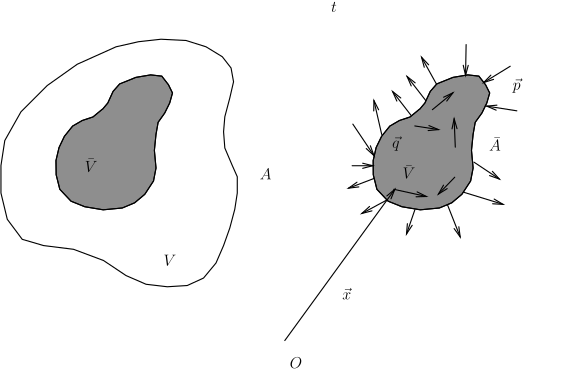
Figure 3.3:Forces and , acting on a subvolume of a body, and position vector with respect to the origin , needed to calculate moments of momentum.
Using a Lagrangian approach, we concentrate on a certain, fixed amount of matter having a volume , a surface and a density . The matter is acted upon by body forces and surface forces . The total moment of momentum[8] of the material points with respect to the origin equals:
The resulting moment of the forces acting on the body with respect to the origin , is given by:
Of course, the moment of momentum can be calculated with respect to any fixed point in space: for convenience we have chosen the origin. According to the law of balance of moment of momentum, the moment, exerted on the matter by the body and surface forces with respect to , is equal to the rate of change of the moment of momentum of the matter with respect to :
Through a laborious derivation, similar to that used for balance of mass and momentum, we can derive the following local formulation of the law of balance of moment of momentum:
i.e., the Cauchy stress tensor is symmetric.