

2 Force and stress
The deformation, described in the previous chapter, may be the result of a variety of causes, e.g. change of temperature, change of chemical composition of the environment, electromagnetic forces, mechanical forces. In this chapter, attention is focused on the mechanical forces as the cause of deformation. Upon application of a mechanical force, a continuum will deform until the internal forces, resulting from the deformation, are in equilibrium with the external forces. The internal forces are most conveniently described in terms of stress.
2.1Forces
2.1.1Body forces
We consider a three-dimensional body with volume and outer surface .
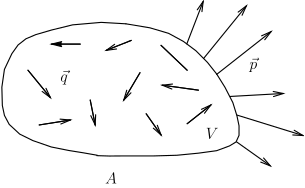
Figure 2.1:Body forces and surface forces , acting on a body.
Next we consider two types of forces that act on the body: body forces[1] and surface forces[2] also called surface traction. Body forces act on all material points in the body. Examples are gravitational forces. Body forces are usually reckoned per unit of mass, and denoted by . In general, they may depend on the position in the body :
The force per unit of volume is given by , where represents the momentary density of the material in kgm.
2.1.2Surface forces
Surface forces are forces that are exerted on the body by the part of the environment that is in contact with the surface of the body. Thus surface forces are exerted on the material points at the boundary of the body. Surface forces are reckoned per unit area of the surface, and denoted by . In general, they may also depend on the position of the boundary of the body:
2.2The true stress or Cauchy stress tensor
2.2.1Definition
Let us again consider a three-dimensional body in its current configuration with volume and a surface . We assume that the body is in mechanical equilibrium, i.e. we assume that sum of the forces acting on the body equals zero. This means that the body will neither accelerate, nor deform.
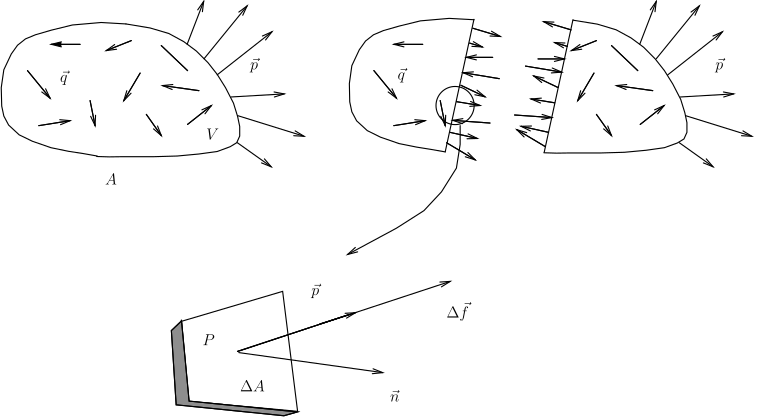
Figure 2.2:A imaginary division of a body in two parts, and the stress vector , acting in a point on the cutting plane.
Now we imaginary divide the body in two parts. To prevent deformation of the separate parts, we replace the forces, previously exerted by the parts upon each other, by a suitable surface force. In general, this surface force will vary with the location in the cutting plane. We consider a small part of the cutting plane with centre . The part has an area , and the sum of the surface forces acting on it equals . Then the traction vector or stress vector[3] in point is defined as:
We now postulate that, for any point in the body, there exists a tensor, the Cauchy stress tensor , that relates the normal unit vector on an arbitrary surface element in that point (in the current configuration) to the stress vector on that surface (in the current configuration) according to:
The Cauchy stress tensor is fully defined on the current configuration. It is therefore often called the true stress tensor, since it is the only stress tensor which is physically meaningful. With respect to an orthonormal basis , the components of the tensor , arranged in the matrix , equal:
To interpret the meaning of the components , we consider the stress vector on a surface with unit normal vector :
Thus, for example the component represents the component in the - direction of the stress vector on the surface with normal unit vector . In general, the component represents the component in the - direction of the stress vector on the surface with normal unit vector .
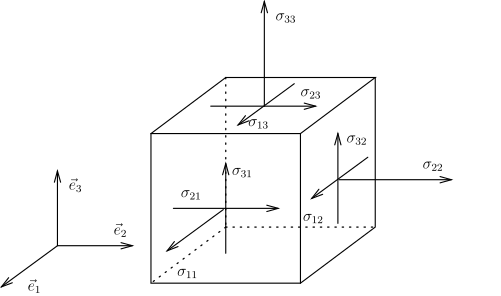
Figure 2.3:Components of the Cauchy stress tensor.
2.2.2Normal and shear stress
The stress vector on a surface through a material point can be written as the sum of two vectors, a vector perpendicular to the surface and a vector in the surface:
The vector is called the normal stress vector[4], and its magnitude is called the normal stress[5]:
with:
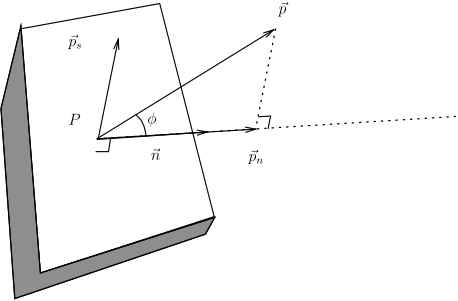
Figure 2.4:Decomposition of the stress vector in a normal stress vector and a shear stress vector .
If is positive, i.e. if is directed along , then is called a tensile stress[6]. If is negative, i.e. if is directed opposite to , then is called a compressive stress[7].
The vector is called the shear stress vector[8], and its magnitude is called the shear stress[9]:
and:
2.2.3Principal stresses
In the next chapter, Section 3.3, it will be shown that the Cauchy stress tensor is symmetric:
Thus the Cauchy stress tensor possesses three real eigenvalues , and . The corresponding eigenvectors , and are (or can be chosen so that they are) mutually orthogonal. We can write in the following spectral form:
Calculation of the stress vector on a special surface with yields:
Thus, the stress vector on these special surfaces is aligned with the normal vector, i.e. only a normal stress is exerted on these special surfaces. Therefore the eigenvalues , and and the eigenvectors , and are called principal stresses[10] and principal stress directions[11], respectively.